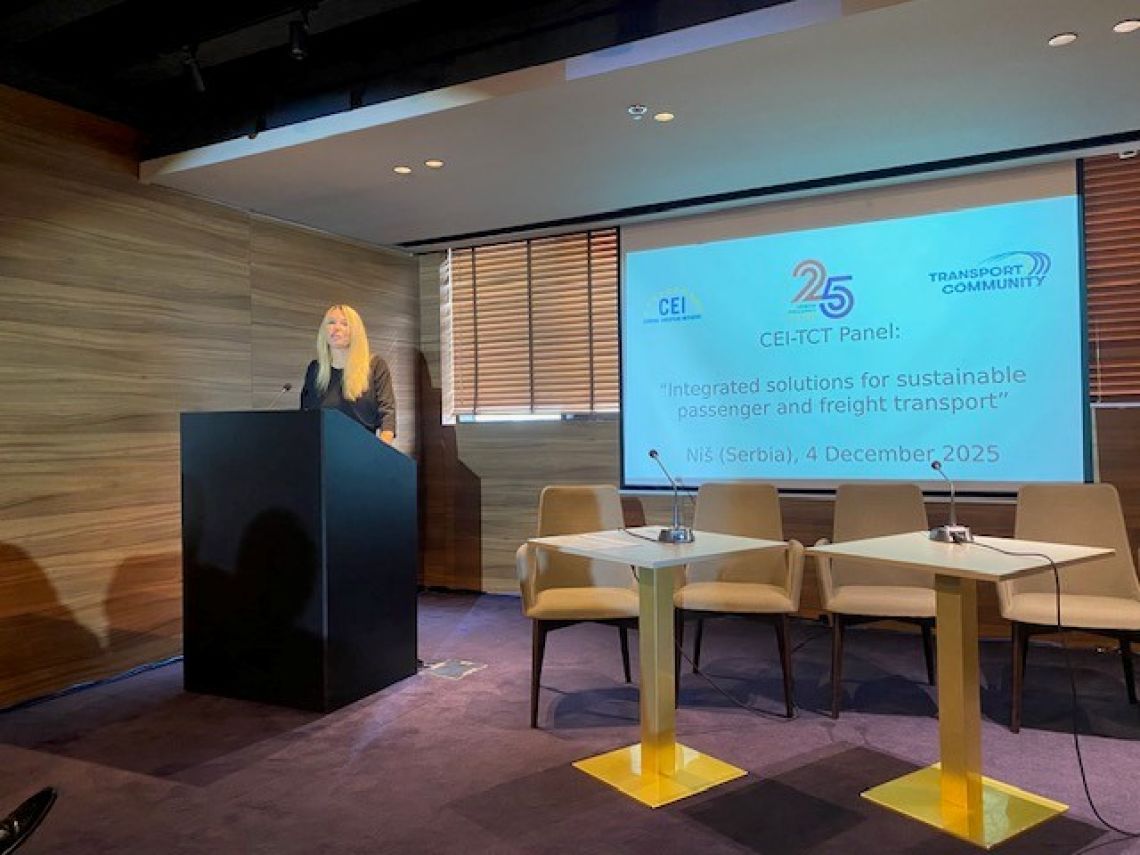
The CEI–TCT Panel on “Integrated solutions for sustainable passenger and freight transport,” held on 4 December 2025 in Niš, brought together a wide spectrum of policymakers, regional organisations, international financial institutions and transport industry representatives for a full day of exchanges on the future of mobility in the Western Balkans. The discussions focused on persistent bottlenecks at border crossings, the modernisation of road and rail links, and the need to advance market liberalisation to create a more efficient, predictable and sustainable transport environment for both passengers and freight. Sessions addressed operational hurdles and strategic priorities, highlighting how fragmented procedures, outdated infrastructure and long waiting times continue to hinder economic competitiveness and regional integration.
Zsuzsanna Kiraly, CEI Deputy Secretary General, underscored the strategic importance of transport connectivity as a driver of broader regional development.
In her remarks, she stressed that “efficient and sustainable transport networks are not only a prerequisite for trade and mobility, but also for social inclusion, economic competitiveness, and ultimately, for EU accession,” calling for deeper digitalisation, enhanced interoperability and better data exchange to modernise border management and reduce congestion.
Furthermore, she outlined the tangible results already achieved through coordinated regional initiatives such as the Green Lanes, which have demonstrated the value of joint action in speeding up freight flows and improving predictability for carriers.
Kiraly also highlighted the need to revitalise key rail corridors, noting the CEI-supported study on the Trieste–Ljubljana–Zagreb–Belgrade railway line as a flagship example of how strategic investments, paired with regional cooperation, can unlock new opportunities for sustainable mobility. Aligning the Western Balkans with EU climate and decarbonisation goals, she observed, will require stronger institutional coordination and increased private-sector participation, but offers long-term benefits for competitiveness and resilience.
The exchanges throughout the panel underlined a shared understanding that no country can address these challenges alone. The concluding discussions reaffirmed a collective commitment to work toward a more integrated, greener and future-oriented transport system capable of supporting economic growth and social cohesion across the Western Balkans.
The event ultimately reaffirmed the strength and relevance of CEI–TCT cooperation as a driving force for advancing connectivity and sustainable transport solutions in the Western Balkans.
For more info: fortuna@cei.int; arsova@cei.int