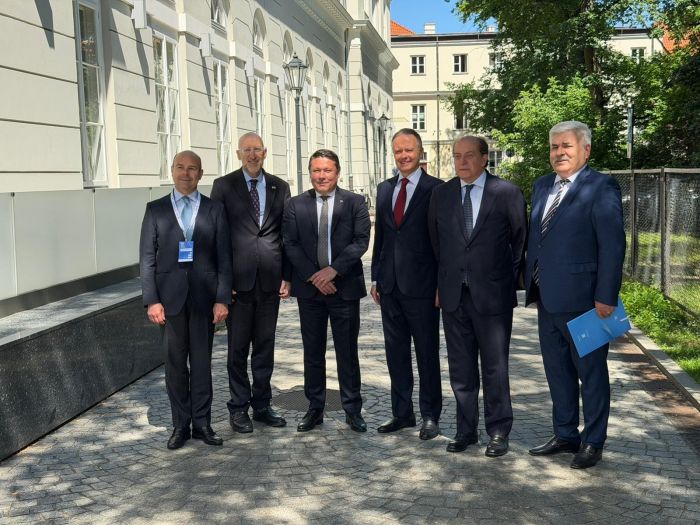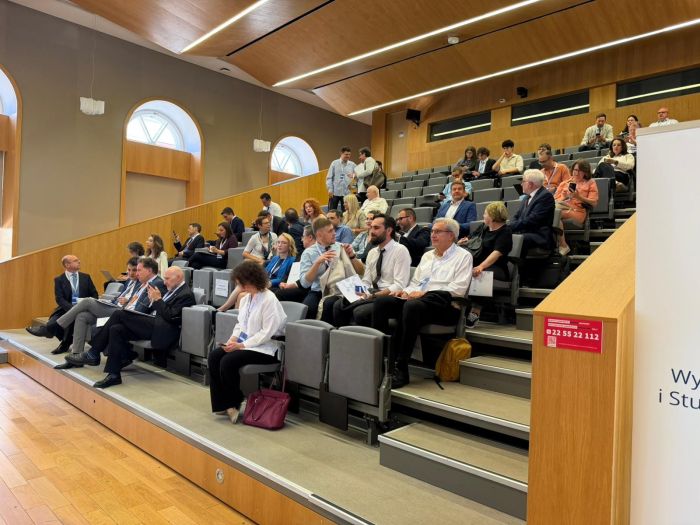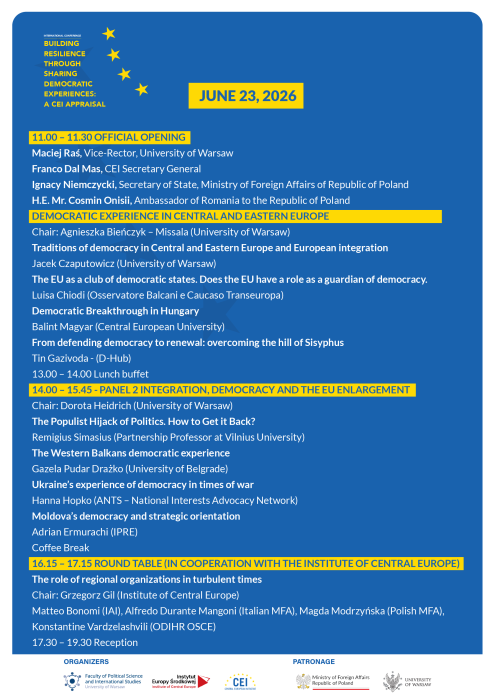
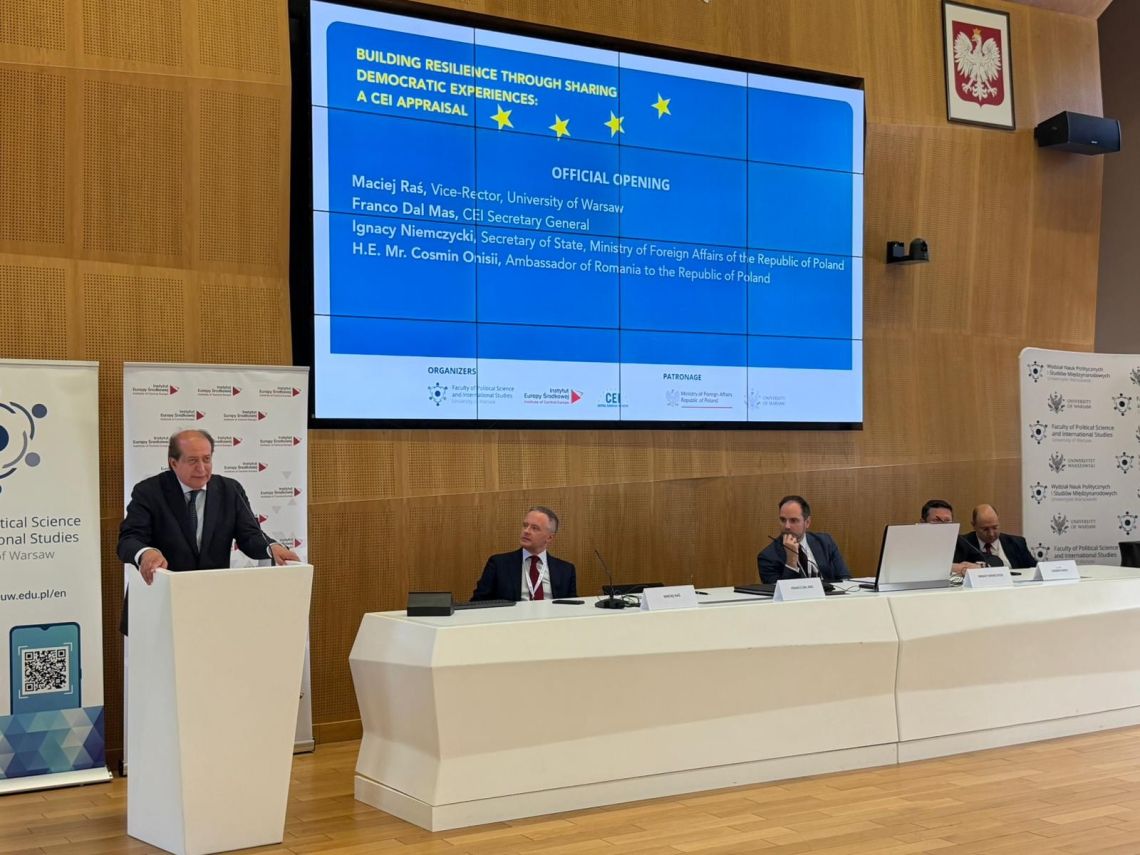
Strengthening the resilience of democratic institutions, supporting the European path of the Western Balkans, Ukraine and Moldova, and promoting regional cooperation as a tool for stability and security. These were the key themes at the international conference “Building Resilience Through Sharing Democratic Experiences: a CEI Appraisal”, organised in Warsaw on 23 June 2026, by the CEI - Executive Secretariat and the Faculty of Political Science and International Studies of the University of Warsaw, with the support of the Polish Ministry of Foreign Affairs and the Romanian CEI Presidency. The event also contributed to the celebrations marking the 30th anniversary of the CEI - Executive Secretariat, established in 1996.
Secretary General Franco Dal Mas recalled that the Organisation was created to accompany the countries of Central and Eastern Europe in their rapprochement with European institutions, stressing that the promotion of democracy and trust between citizens and institutions remained one of its core objectives.
“Democracy is never a definitive achievement. It must be continuously strengthened, defended and renewed through dialogue, cooperation and the direct involvement of people,” Dal Mas stated, highlighting how collective security increasingly depends on the ability of democratic institutions to protect freedoms and pluralism while resisting threats stemming from disinformation and external interference.
The gathering - taking place a few days after the formal opening of EU accession negotiations with Ukraine and Moldova - was marked by the launch of the first negotiation cluster dedicated to the rule of law, democratic institutions and fundamental rights. This development was welcomed by the CEI, which continues to support its member states on their path towards full European integration.
Throughout the discussions, participants exchanged views on the democratic experiences and trajectories of the various constituencies represented within the Initiative; reflected on the benefits of belonging to a community of European states united by democratic values; and explored possible responses to the rise of anti-democratic narratives capable of undermining the European project, including in relation to the enlargement process.
In his remarks, Dal Mas also underlined that democratic resilience, including with regard to candidate countries and the reconstruction of Ukraine, could not be separated from the strengthening of institutional capacities and the presence of solid, transparent and accountable public administrations. In this context, the event also sought to anticipate the Ukraine Recovery Conference 2026, scheduled to take place in Gdańsk on 25–26 June, by integrating the debate on reconstruction with the value-based perspective of democratic systems.
The conference brought together representatives of institutions, academia and diplomacy from several European countries, providing an important opportunity to discuss the challenges Europe is currently facing in a phase marked by EU enlargement, Ukraine’s reconstruction and the need to reinforce the resilience of democratic institutions.
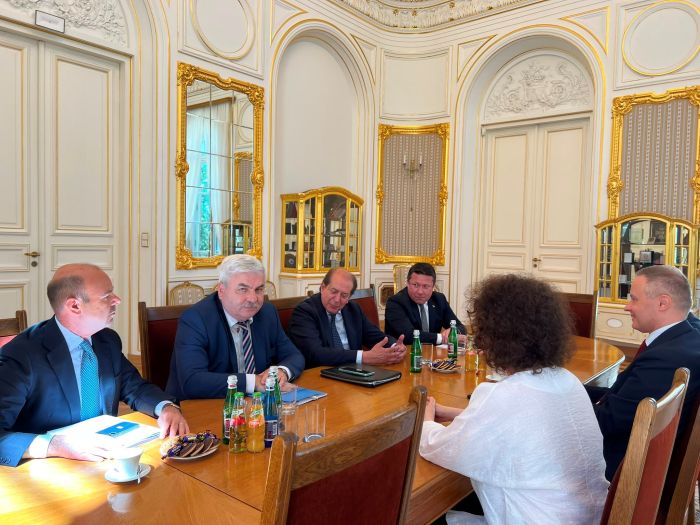
On the margins of the conference, Secretary General Dal Mas also met with the Ambassador of Italy to Poland, Luca Franchetti Pardo, for an exchange of views on key regional dossiers and prospects for cooperation in Central and Eastern Europe.