
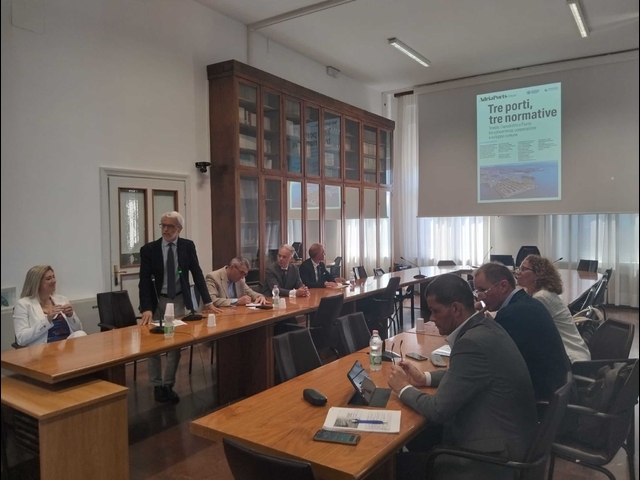
(ANSA) - UDINE, 25 GIU - The University of Trieste and Adriaports today organized a conference on possible alliances and forms of cooperation among the ports of Trieste, Koper, and Rijeka to achieve shared goals, titled "Three ports, three regulatory frameworks - Trieste, Koper and Rijeka, between competition, cooperation and common development." Among the speakers was Massimo Campailla, from the Department of Legal Sciences at the University of Trieste. He explained, "The meeting stems from an idea that periodically resurfaces," namely, cooperation among these three ports, which could take place on various levels. There is also a discussion of a possible common governance model. In any case, we are not economists, so we do not intend to provide solutions but rather tools for those who must decide whether and what kind of cooperation to pursue. One issue that, in my view, is still not sufficiently addressed," he added, "concerns the regulations governing these port systems. That is where we must start to work together." Also speaking for the Trieste University, Giuseppe Borruso, from the Department of Economics, observed that "the very geographical proximity of these three logistics and port hubs, where competition is inevitable, makes integration and cooperation necessary." Professor Iva Tuhtan Grgić, of the Faculty of Law at the University of Rijeka, recalled that "our port consists of two terminals, the old one and the new one, which are in competition with each other." In Croatia, she added, "Port Authorities have been established to regulate the delicate balance between competition and cooperation for the development of the ports." Regarding Koper, Professor Mitja Grbec of the University of Primorska's Faculty of Management underlined that "Luka Koper manages the port." It is Slovenia's only commercial port, where rail traffic accounts for 50% of total traffic, according to the conference. The port operates under a dual model, in which the state handles regulation while Luka Koper manages the commercial side. (ANSA).