
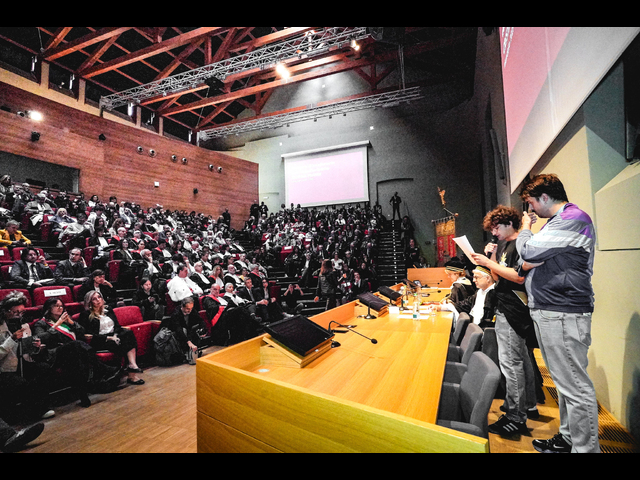
(di Francesco De Filippo) (ANSA) - GORIZIA, MAY 31 - "Education begins with education in the family, with education in reading. If we fail in this area, no school will be able to fill this gap in children." Speaking thus is Mirt Komel, writer and teacher of Philosophy and Modern Literature at the Faculty of Social Sciences, Dept.Cultural Studies University of Ljubljana, on the sidelines of a meeting. Komel is concerned about the "growing generation gap given the fact that young people no longer read books" resulting in cultural deterioration. "In general," Komel says, "the book as a cultural object, as the basis of knowledge, is no longer part of the everyday life of young people, and other study devices fail to give an equal education, especially in a university like Social Sciences where teaching is largely composed of reading. It's not the students' fault: "Adults, parents don't read anymore either," the lecturer points out, "they criticize kids for not reading and just using their phones, but they do the same. A generalized phenomenon of our societies: "Too much Internet and very little reading. The book loses value as a study tool and as a tool for pleasure." To run for cover in 2023, The Ljubljana Manifesto for Promoting Reading at a High Level was developed. "Today people read more on social media, which are, however, structured for attention that lasts eight seconds. Reading poetry, novels, which is also the work of the social sciences, requires attention for a much longer time," Komel points out. So, since "the mental discipline is not suitable for in-depth study of philosophy, anthropology, which are more challenging texts than a novel," on the faculty we have "implemented The Manifesto by initiating many parallel activities such as a reading seminar where students read literature, novels, in addition to the rest of the courses. This year we read the whole Lord of the Rings trilogy. That's how they learn to read; we hope they will infect their peers as well." Specific reading spaces have also been carved out in the faculty for this. Finally, Komel noted that Slovenian high schools no longer study Greek and Latin, "considered languages too difficult for students," but still study them in Slovenian schools in Italy, which therefore "give an intellectual foundation without which our schools have no future. As a result, many parents - Italians, Slovenes from the minority in Italy, Slovenes from Slovenia - enroll their children in the latter institutions." (ANSA).