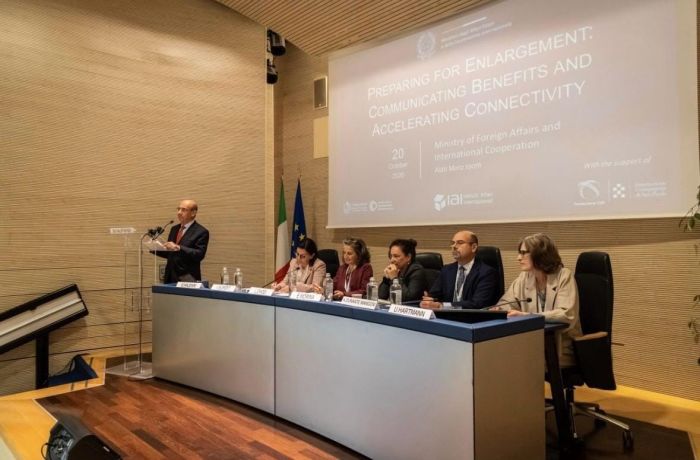
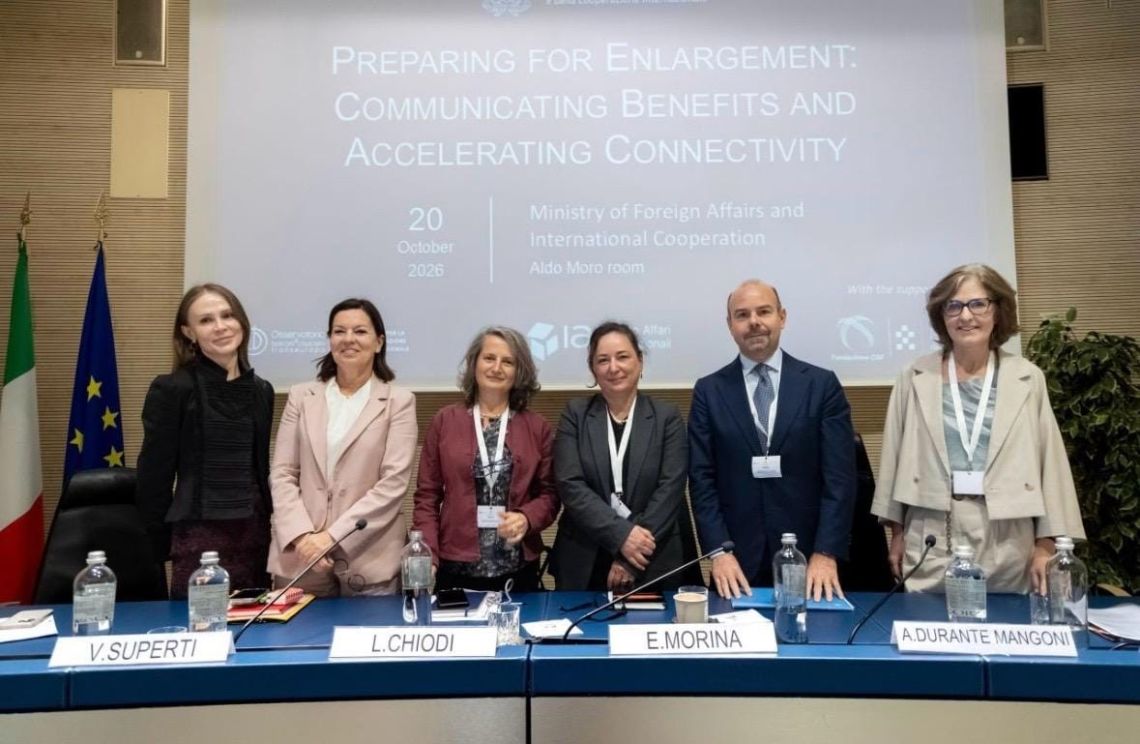
On 20 October in Rome, Minister Plenipotentiary Alfredo Durante Mangoni, Italian National Coordinator for the Central European Initiative (CEI), took part on behalf of CEI Secretary General Franco Dal Mas in the fourth edition of the conference “New Visions for the Western Balkans – Preparing for Enlargement: Communicating Benefits and Accelerating Connectivity”, held at the Italian Ministry of Foreign Affairs and International Cooperation.
Organised by the Istituto Affari Internazionali (IAI) and the Osservatorio Balcani e Caucaso Transeuropa (OBCT), in cooperation with the Ministry, and held within the framework of Italy’s Presidency of EUSAIR, the conference brought together institutional representatives, policymakers and experts to discuss how effective communication and stronger connectivity can support the European integration of the Western Balkans.
The event opened with remarks by Ambassador Riccardo Guariglia, Secretary General of the Italian Ministry of Foreign Affairs and International Cooperation, representing Deputy Prime Minister and Minister of Foreign Affairs Antonio Tajani, and by Michele Valensise, President of IAI-Istituto Affari Internazionali.
Discussions focused on communicating the economic, political and social benefits of EU enlargement, strengthening public trust and countering misinformation. Attention was also given to accelerating connectivity through transport, energy and digital networks, promoting economic convergence and regulatory alignment, and delivering tangible benefits to citizens ahead of full EU membership, namely by broadening gradual integration measures in several fields of European integration: single market, energy, security and defense. The role of regional cooperation frameworks, including EUSAIR and the Adriatic-Ionian Initiative, was highlighted as a means of supporting closer integration between the Western Balkans and the EU.
Following also the recent ministerial meetings held in the margins of UNGA 81, Amb. Guariglia renewed the strong political commitment by Italy to actively promote the accession of Western Balkans to the EU. IAI President Valensise highlighted the relevance of such support in a potentially decisive phase for EU enlargement where there is a strong Italian interest in seeing it succeed.
Min. Durante Mangoni - who joined the discussion around communicating benefits of the enlargement, alongside Valentina Superti of DG ENEST at the European Commission, Ulrike Hartmann of the Austrian Federal Ministry for European and International Affairs, Una Hajdari of POLITICO and Engjellushe Morina of the European Council on Foreign Relations - underlined that
“the costs of the non-enlargement by far exceed the cost of enlargement. Legitimate concerns should not be dismissed but must be kept apart from distorted narrative and storytelling, where polarized information ecosystems may cause misunderstandings. It is important to explain the advantages and possible solutions by data and rationale, while contextualizing risks. Regional cooperation developed in the CEI framework may help countries work together, learn from each other, overcome differences and build trust”.
The CEI’s participation reflects its longstanding commitment to the reunification of Europe and its bottom-up approach to regional cooperation. Through institutional partnerships, concrete projects and people-to-people exchanges, the CEI helps bring candidate countries closer to the EU and makes the benefits of European integration more tangible for citizens.