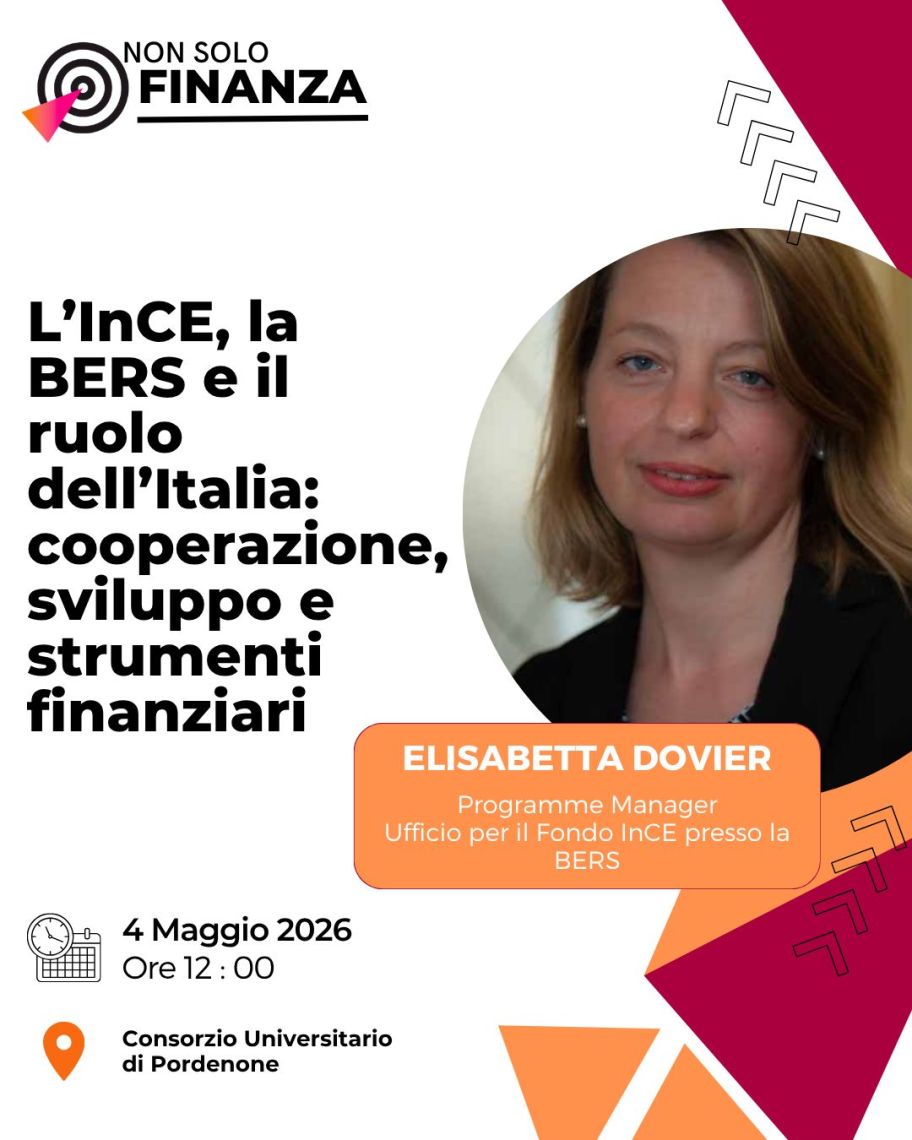
The role of regional cooperation and development finance in supporting growth, connectivity and European integration across Central, Eastern and South-Eastern Europe was at the centre of a lecture delivered by Elisabetta Dovier, Programme Manager of the CEI Fund at the EBRD, within the framework of the “Non Solo Finanza” lecture series organised by the Consorzio Universitario di Pordenone.
Addressing students of banking, finance and economics, the lecture retraced the evolution of the CEI since its establishment in 1989 and highlighted its transformation into a regional platform capable of translating political dialogue into concrete action through development-oriented initiatives and institutional cooperation.
Particular emphasis was placed on the partnership between the CEI and the European Bank for Reconstruction and Development, notably through the CEI Fund at the EBRD financed by Italy, which represents one of the CEI’s most operational and impactful instruments in supporting technical cooperation, know-how transfer and the European integration process of non-EU CEI Member States.
Established in 1992, the Fund has received over EUR 61.5 million in contributions from Italy and has become a concrete instrument for promoting development, governance and regional cooperation throughout the CEI area. Through its Technical Cooperation Programme, which has financed 209 projects worth EUR 38 million and generated a leverage ratio of 1:262 in mobilised international investments, as well as through the Know-how Exchange Programme (KEP), which has supported 175 projects since 2004, the Fund has contributed to strengthening institutional capacities and supporting strategic reforms.
The lecture underlined that the Fund’s key added value lies in its ability to combine technical assistance, project preparation and strategic investment support, helping make projects more bankable, sustainable and attractive to international financial institutions and investors. Concrete examples were presented in sectors such as infrastructure, energy, connectivity, circular economy, environmental sustainability and digitalisation.
Students were also introduced to key concepts of development finance, including transition impact, additionality, leverage effect and blended finance, through practical examples of initiatives implemented in the Western Balkans and Eastern Europe.
“The CEI represents political cooperation. The EBRD represents development finance. The CEI Fund at the EBRD represents the intersection of these two dimensions, with Italy at the centre,” Dovier underlined.
“Finance is not only about numbers, rates and spreads. It is also the capacity to create conditions, reduce risks, build trust and generate development. Today more than ever, this is an essential contribution to stability and growth across Europe,” she added.
The lecture further highlighted how the cooperation between the CEI, the EBRD and Italy constitutes a concrete model of international partnership aimed at fostering sustainable development, regional connectivity and gradual convergence towards European standards.
Building on the 2025 Roadshows organised across the Western Balkans in cooperation with Italian embassies in Belgrade, Skopje, Tirana, Podgorica and Sarajevo, last year, the CEI-Executive Secretariat and the Italian Ministry of Foreign Affairs and International Cooperation, together with ITA – Italian Trade Agency and the Italian Office at the EBRD, are planning to organize promotional events in Milan and Rome aimed at raising awareness among Italian businesses and institutions of the opportunities offered by the Fund.
For more info: dovier@cei.int