
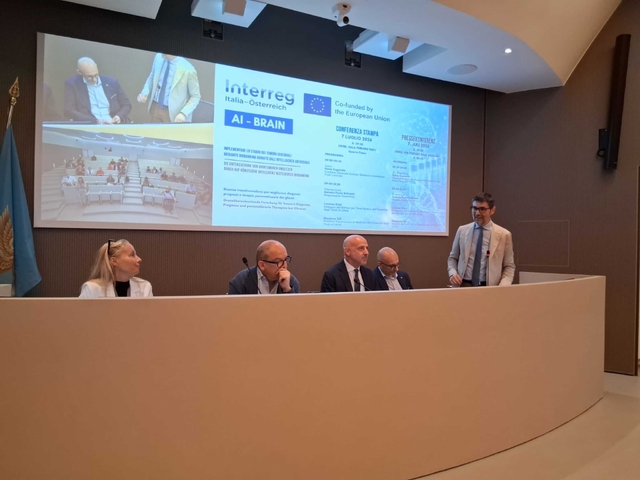
(ANSA) - UDINE, 07 LUG - A digital bridge between Friuli and Austria to put artificial intelligence at the service of the fight against gliomas, rare and aggressive brain tumors. That is the goal of the Interreg Italy-Austria AI-Brain project, presented in Udine, with the Friuli Centrale University Health Authority (Asufc) as lead partner. The project will run from 2026 to 2028 and has a budget of 784,611 euros. For ASUFC Health Director David Turello, it represents "a convergence of activities between Italy and Austria, among research centers, to bring together all available knowledge" on a disease "with a very high mortality rate." The project will integrate biobanks, clinical data and molecular biology "with the utmost respect for privacy," to bring research "to the patient's bedside." Project scientific coordinator Paolo Antonio Beltrami outlined three main pillars: a cross-border biobank network, the use of AI to extract information from medical reports and clinical letters, and advanced diagnostics using third-generation sequencing and proteomics. "Each institution has only a limited number of samples: to do research, resources need to be pooled," he explained. For Lorenza Driul, the University of Udine rector's delegate for the medical area, AI-Brain confirms the university's international vocation. Gianluca Tell, director of the University of Udine's Department of Medicine, emphasized the connection among university research, teaching and clinical practice. Representing the Aviano National Cancer Institute, researcher Riccardo Spizzo stressed that "building networks within the region and beyond, with international institutions, is essential to create critical mass." "Challenges know no borders," said Anna Favotto, of the Interreg Regional Coordination Office, noting that the partnership brings together five organizations: the Friuli Centrale University Health Authority, the Aviano National Cancer Institute, Fraunhofer Austria Research, the Medical University of Innsbruck and Plus srl of Trieste. (ANSA).