
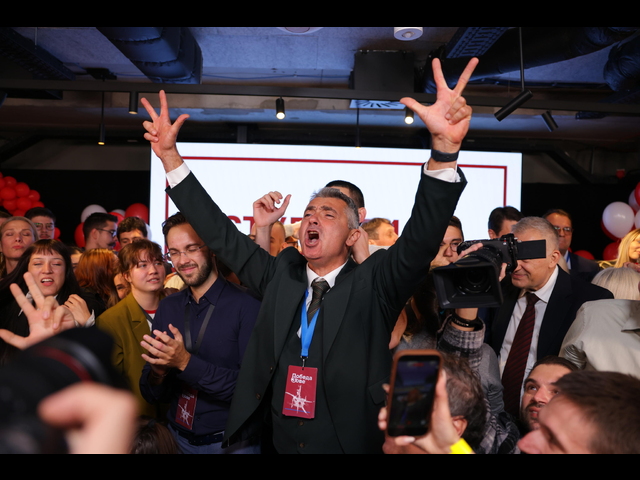
(AGGIORNA E SOSTITUISCE IL SERVIZIO DELLE ORE 20.49) (di Fabio Govoni) (ANSA) - BELGRADO, OCT 25 - The Students won the early parliamentary elections in Serbia. And across the country, as broadcast live on TV, celebrations erupted in the streets. According to the results—which are still preliminary but are unlikely to change substantially— they secured 52% of the vote, which would give them 138 of the 250 seats in the National Parliament, compared to the 39% obtained by former President Aleksandar Vučić's United Serbia list, which would thus hold 104 seats. No other coalition in the race, according to projections, has crossed the 3% threshold, except for the small ethnic minority parties, which are not subject to this requirement. In a surprise move, Vučić himself was the first to appear live on RTS television to announce that he had "lost the election," after his previously announced live appearance had raised fears that he intended to declare victory instead. Vucic, with a somber but composed expression, said that the students had waged an "unfair and deceitful" election campaign and that he would make no concessions to the opposition, but he acknowledged "the students' victory." Speaking on behalf of the latter, candidate Radomir Sajčić told RTS that "Serbia has finally taken its destiny into its own hands, with a result that rewards nearly two years of struggle." The top candidate on the student slate, cardiologist Ilija Srdjanović, noted that his country has "turned its back on a tyrant: We are moving toward a better Serbia." The students were rewarded with a record voter turnout, which neared 70 percent—a figure not seen in at least 30 years and one that commentators had long predicted, arguing that it would work in the students' favor. The celebrations erupted as, with the polls already closed, a tense atmosphere grew in downtown Belgrade, with massive police deployments and the feared presence of provocateurs. These were elections that the former president—who had resigned in September to take on the student challenge as the head of the United Serbia list—felt he might lose. His statements in recent months betrayed his nervousness, as he insisted on labeling the students "destroyers" and "unreliable," claiming they were "manipulated by foreign powers" hostile to Serbia. There were extremely long lines at the polling stations well before they opened at 7 a.m. Students advised their constituents to vote early, while tensions ran high from the very start—a palpable atmosphere even in the streets—fueled by fears that fraud, irregularities, and manipulation could undermine an election being closely watched by Europe, America, and even Russia. Pre-election predictions, depending on the pollsters' leanings, alternately favored either United Serbia or the Student List, which prepared meticulously for the election by training more than 16,000 list representatives and 60,000 poll watchers outside the polling stations, who worked alongside the more than 16,000 observers—both international and national—present throughout the country, including delegations from the OSCE, the ODIHR, the Council of Europe, and the European Parliament. Exit polls are not permitted in Serbia. The first projections—released many hours after the polls close by some of the associations and polling organizations tracking the election, such as CeSid/Ipsos Serbia and Crta—appear before the National Election Commission (RIK) releases its first concrete results, when data from the polling stations begins to pour into its data collection centers, joining the potential votes of the approximately 100,000 Serbs voting abroad and the hundreds of potential votes from Bosnian Serbs residing in Bosnia and Herzegovina who have been granted dual citizenship. Eighteen slates were in the running for the 250 seats in Serbia's unicameral parliament, which are elected through a proportional representation system with a single constituency and a 3% threshold. (ANSA).