
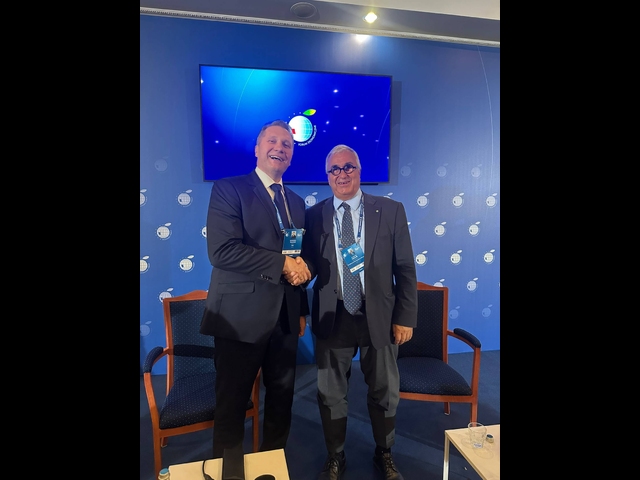
(ANSA) - KARPACZ, 09 SET - The future of the European Union hinges on its ability to return to its founding principles: ensuring peace and building a common market capable of making member states competitive. This is the central theme of the discussion between Francesco Tufarelli, Director-General of the Presidency of the Council, and Przemyslaw Czarnek, in a dialogue dedicated to the reform and future of Europe at the 35th Karpacz Economic Forum in Poland. According to Tufarelli, the EU is facing a particularly complex phase. The war in Ukraine has highlighted the need to strengthen foreign and defence policy, not least in light of a relationship with the United States that is set to change. "What others used to do, we now have to do ourselves," he observes, arguing for the need for greater European strategic autonomy. However, the single market remains the main foundation upon which to build this autonomy. According to Tufarelli, individual states are too small to stand up alone to major powers such as the United States, China and Russia. Common policies are therefore needed, including in the areas of defence and strategic infrastructure, to avoid fragmentation that would weaken Europe. Czarnek, on the other hand, insists on the need to boost competitiveness. In his view, energy policies and the Green Deal have increased costs for European businesses, making it harder for them to compete on global markets. The aim, he argues, should be a Europe capable of guaranteeing prosperity and economic freedom for its citizens, without turning into a 'single state' dominated by the strongest countries. Enlargement is also on the agenda. Both recognise its importance, but make it conditional on appropriate terms and a suitable timeframe. Czarnek looks in particular to Ukraine, supporting its future accession to the EU once the necessary conditions have been met. Finally, the issue of Christian values. Tufarelli recalls the failure of the attempt to include them in the European Constitution and considers that cultural battle to be still relevant today. For Czarnek, on the other hand, the Union should take a step back with regard to the values of individual countries, respecting their differences. A possible compromise, for both, is a stronger Europe precisely because it is capable of valuing its own diversity. (ANSA).