
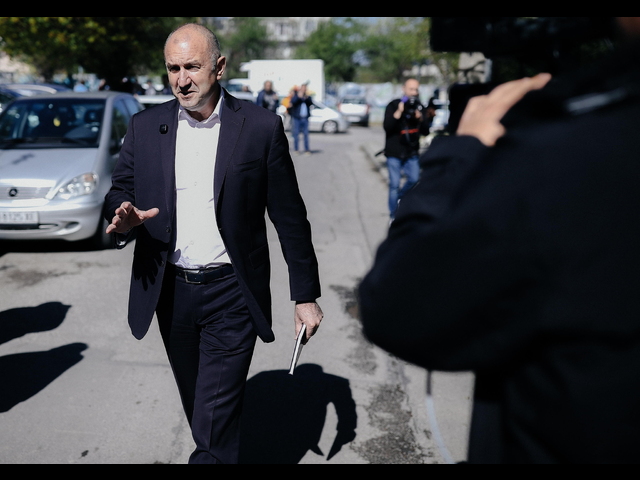
(ANSA) - SOFIA, APR 20 - Former president turned anti-corruption tribune, considered pro-Russian and even euroskeptic, Rumen Radev, is going as expected toward victory in Bulgaria, on the ballot for the eighth time in five years. Indeed, toward a triumph, if the partial result of the count, at 65 percent, is confirmed, giving him an absolute majority of the 240 seats in Bulgaria's single-chamber parliament, allowing him not to ally himself with anyone, contrary to what exit polls had led to assume, which also gave the Socialist Party in the balance, which instead fails to make it over the 4 percent barrier. A result that would be a turning point, if not a substantial decisive one, in the political life of the Balkan country. For the first time, the conservative Gerb party of the historic 'ruler' Boyko Borissov collapsed, placing second with 15.4 percent: less than half the votes that went to Radev's newly formed 'Progressive Bulgaria,' which with only 45.9 percent would, under the allocation system, obtain an absolute majority. In January, Radev, a 62-year-old former top gun and air force commander, in an unprecedented act, announced his resignation from the presidency and declared his intention to take the field to "destroy the oligarchic model and fight the mafia that has infiltrated all levels of government in the country" thanks, according to him, to the conservative Gerb governments, with the tacit complicity of the Turkish minority party (Dps). Parties he said he wanted nothing to do with even if he did not exceed 50 percent. If the anti-corruption and anti-oligarch programmatic slogans are well understood domestically, foreign policy positions are not. As president, Radev had called, without getting it from parliament, for a referendum on Bulgaria's entry into the euro as "premature." On Ukraine Radev, a former air force commander, seems very cautious: yes, "Russia is an aggressor," he has always admitted, but the issue should be resolved "not with weapons but with diplomacy." In recent days he has been clearer and more categorical: "Military and financial aid should not be given to Ukraine. I am not pro-Russian, I have a pro-Bulgarian position, that is, realistic. On Kiev, rash decisions are being made, which do not take into account the consequences. This is leading Bulgaria and the EU toward a crisis." For these positions of his, several observers in Bulgaria and abroad have called him "pro-Russian and euroskeptic," even a potential "new Orbán," excessive definitions according to other analysts. Based on the still-ongoing count, the conservative Gerb party would get 13.1 percent, an unprecedented slump after having ruled the country for more than 10 years in the past, and a drubbing for its historic leader Borissov. Also entering parliament, according to Trend, are the Liberals, the most pro-European of the Bulgarian parties, with 11.4 percent of the vote, the Turkish minority party Dps with 6.0 percent of the vote, and the nationalists of 'Vazrazhdane' ('Rebirth') with 5.1 percent of the vote. Yet another early vote in Bulgaria was held amid economic deadlock and social malaise over the galloping cost of living since the introduction of the euro earlier this year. The latest of Bulgaria's successive parliamentary crises in recent years erupted last December, when mass protests across the country against the government, accused of corruption and collusion with mafia circles, forced Premier Rossen Zhelyazkov and his government to throw in the towel. A Gerb exponent, Zhelyazkov led a coalition with socialists and Itn populists, three historically rival parties. (ANSA).