
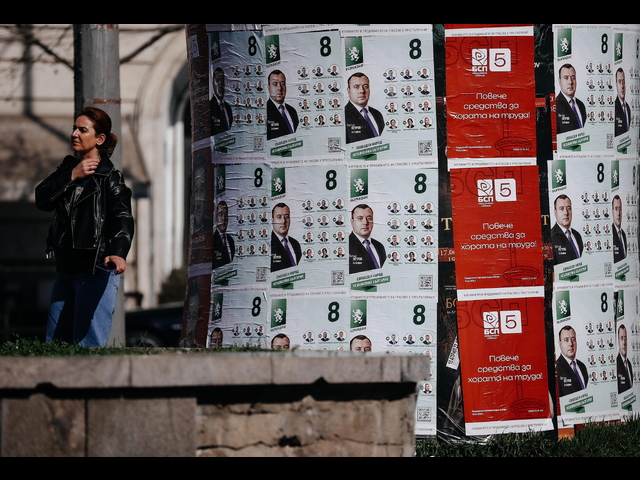
(di Atanas Tsenov) (ANSA) - SOFIA, APR 18 - A Bulgaria on the brink of despair, crushed between inflation and pervasive, rampant corruption, votes Sunday for the eighth time in five years, with a new element that raises both hopes and fears: the new lineup with which former Republic President Rumen Radev, a former top gun unaffiliated with any party and who resigned resoundingly last January, goes to the polls in pole position, promising to fight corruption, the mafia and instability. Bulgarian society is in the grip of extreme anxiety: data collected by the demoscopic agency Sova Harris are merciless: as many as 69.8 percent of adult citizens admit to fearing that they will not be able to meet their basic needs, mainly due to galloping inflation. When two-thirds of the population feel 'on the brink,' the electoral process ceases to be a competition of ideas and becomes a survival instinct, experts observe. This social pressure would be the main catalyst for the expected high voter turnout, which could bring more than 55 percent of voters to the polls, compared to 45 percent in previous elections. People will vote not for parties but against poverty, Sova Harris concludes. The latest of Bulgaria's successive parliamentary crises in recent years erupted last December, when mass protests across Bulgaria against the government, accused of corruption and collusion with mafia circles, forced Premier Rossen Zhelyazkov and his government to throw in the towel. An exponent of the conservative Gerb party, Zhelyazkov led a coalition with socialists and Itn populists, three historically rival parties. Then on January 19, in an act unprecedented in Bulgarian history, he announced, his resignation the president of the Republic, Rumen Radev (62), replaced by his deputy, Iliana Iotova. Radev, a former top gun and former commander of the Air Force, resigning from office a year before the deadline, declared his intention to take the field with a new breakaway party, 'Progressive Bulgaria,' with which Radev says he is ready to "destroy the oligarchic model and fight the mafia that has infiltrated all levels of government in the country." But if his programmatic slogans are well understood domestically, his foreign policy positions are not. As president, Radev had called, without getting it from parliament, for a referendum on Bulgaria's entry into the euro as "premature." On Ukraine Radev seems very cautious not to say ambiguous: yes, "Russia is an aggressor," but the issue should be resolved "not with weapons but with diplomacy," a position similar to that on the Iran conflict. Competing with Radev are as many as 24 political formations (14 parties and 10 coalitions) to fill the 240 seats from which Bulgaria's unicameral parliament is composed. All demographic agencies take Radev's 'Progressive Bulgaria' victory for granted but without an absolute majority. According to the Trend agency, it would have 33.2 percent of the vote, while only four other formations would cross the 4 percent vote threshold and enter parliament. After more than a decade of victories and unstable governments, the Gerb conservatives would drop to second place with 19.1 percent-a severe beating for the charismatic leader, Boyko Borissov, several times premier and still an eminence in Bulgarian politics. They would be followed by the liberals of the Pp ('Let's continue the change') with 11.6 percent. In fourth place would be 'Dps-New Beginning,' a Turkish minority party, with 10.4 percent. The nationalists of 'Vazrazhdane' (7.1 percent) would also enter. Other big news is that for the first time the Socialist Party is likely to be left out of parliament. According to the latest census, Bulgaria's population is 6.6 million, of which 1.4 million are living abroad. (ANSA).