
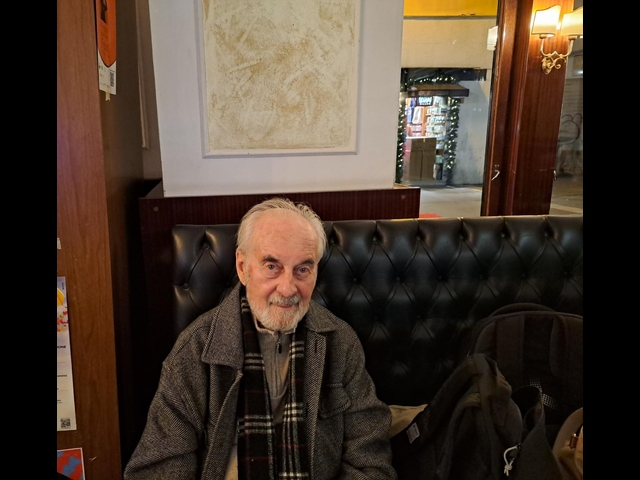
by Francesco De Filippo (ANSA) - TRIESTE, DEC 5 - The dinner at Zanzotto's house consumed on an ironing board in the absence of a table, Zigaina's secret 'closet' or even Montale's 'let's not take ourselves too seriously': Mladen Machiedo, born in 1938, a Croatian from Zagreb, writer, poet, publisher, translator, and lifelong lecturer in Zagreb, tells his story in a film-interview, "The Non-Ordinary Everyday Life of a Croatian Italianist." And he recounts anecdotes about the quirks, peculiarities, and sharpness of Italian writers he has frequented throughout his life. A ferryman of Italian culture in former Yugoslavia through translations of Montale, Campana, Calvino, and Pavese, Machiedo published volumes and essays on literature in Croatian and Italian; of Mediterranean (the root of his surname, Macedo, has Portuguese derivations) and Central European blood, he studied at the Normale in Pisa (1969-1970). One of his encounters with the poet Andrea Zanzotto was hilarious: "In Milan it was almost a party if Bartolo Cataffi was there: lavish dinners, with Sicilian wines. With Zanzotto it was different: I was at his house, I ask him, 'are you hungry?' And he, in dialect, 'I don't feel so well, xe un negozio zo' ... a cold dinner.' We do the shopping, Roman style everything in half; we go back up, in his study there is no table and at the desk you couldn't put your feet in. So he takes an ironing board, I sit on the sharp side, he on the other, in between the food he bought." For Machiedo, Zanzotto is "a curious example of concentration on verbal molecules. With the minimum he tries to penetrate the unknown starting from exquisite particularities of language. But when he is a critic he goes out of himself and is extraordinary: as a critic he lives long, as a poet he is for a small circle." Montale liked "to nickname himself Eusebius; he had a Pirandellian trait. 'Let's not take ourselves too seriously' was his lesson, enduring." When he won the Nobel Prize, "in front of his house in Milan was full of journalists, whom he did not receive. I was his translator and went up." Machiedo has lived "in four states, never changing places," has "survived two wars, but the third one is not survivable." "I published Pasolini's, 'I intend freedom as a death of wounds specially sought,' the death prophesied by him, it was the painter Giuseppe Zigaina who discovered him when speaking of 'suicide by proxy.' Critics cite him as Pasolini's friend never as his literary critic." "I went to see Zigaina, in Friuli, he let me into a closet-this is not known in Italy-it was wallpapered with Pasolini. I discovered an extremely versatile and modest man." Ruggero Jacobbi? "No less brilliant than Umberto Eco; genius in voice and writing. I speak of him and Cataffi as older brothers." "I write by hand then copy the text on a typewriter and a collaborator," he recopies them on the PC; he does not have a driver's license-"I lived in Zagreb near a streetcar stop"-he describes himself as "dated" and literarily "heir to modernisms. One like me fatally, thanks to longevity has to live among the post-moderns, so brevity imposes itself." Far from Gadda, he feels more akin to Alberto Savinio. Machiedo thinks and speaks four languages correctly, began studying Italian learning it from Sanremo songs; translates from Italian, French, Spanish, Portuguese. The film "The Non-Ordinary Everyday Life of a Croatian Italianist" is produced by J.C. Damir Murkovic for the Croatian Community of Trieste, is edited by Cristina Bonadei, and directed by Matteo Prodan. (ANSA).