
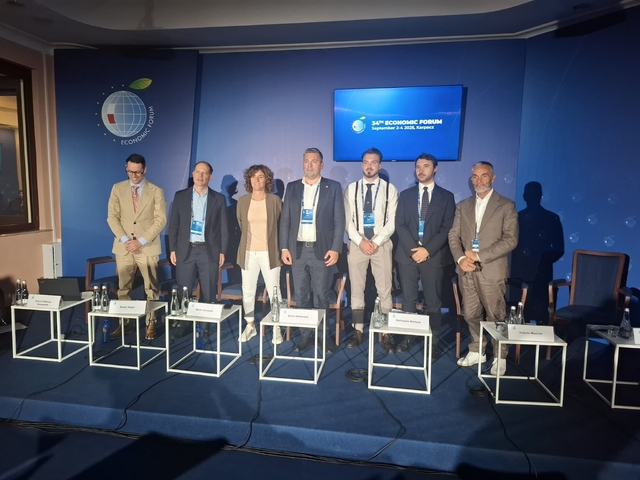
(ANSA) - KARPACZ, 06 SET - Football is a global industry, a diplomatic tool, a technological platform, a social lever and an arena where cultural and emotional factors continue to carry as much weight as economic ones: this was the conclusion reached at the 34th Economic Forum in Karpacz, Poland, during the panel discussion "Shooting for goal: new commercial opportunities in football", moderated by Narcís Pallares Domenèc. According to Simon Kuper, a writer for the Financial Times, football cannot be viewed exclusively as a business, because the heart of the phenomenon lies elsewhere: owning a club, he explained, is almost never a profit-oriented operation. Rather, it is a form of self-promotion, "as demonstrated by Silvio Berlusconi's parable with Milan". For Marta Carissimi, head of women's football at Genoa and former professional footballer, 'women's football is no longer just an emerging niche, but a reality that is transforming the global sporting landscape'. 'It is no coincidence,' she added, 'that many innovations, from data management to technology on the pitch, were first tested in women's football before making their way into the top men's leagues'. In Latvia, on the other hand, football is not the national sport, but this is precisely why it represents a unique opportunity. According to the representative of the Latvian Football Federation, Karlis Boitmanis, through European programmes such as Erasmus, football has become an educational and social tool capable of creating cohesion: the goal is not so much to maximise revenue as to use football as a lever to improve society, offer opportunities to young people and strengthen the sense of community. Valerio Mancini of the Rome City Institute emphasised the creation of the Office for Sports Diplomacy at the Italian Ministry of Foreign Affairs. 'This initiative,' he said, 'reflects the new awareness of governments that sport is not entertainment, but a tool of soft power, capable of promoting national identity, attracting investment, generating tourism and consolidating international relations.' Mancini then recalled the importance of the local dimension, citing the Italian case of L'Aquila 1927, "The people's team", as a model of a club rooted in the community, sustainable and at the same time economically sound. The director of the Social Football Summit, Massimo Tucci, shared his experience of organising global events in the world of football for many years. 'Football,' he said, 'is no longer just a sport: it is a cultural and economic platform that has an impact comparable to that of the major entertainment industries.' Guillaume Mertens of the World Football Summit offered the perspective of someone who works every day as a global connector between clubs, companies and institutions. 'In recent years,' he said, 'we have built a platform with the WFS where football is no longer just a game, but an economic, social and cultural driver. With over 29 events worldwide and a community of more than 145,000 professionals, we see how collaboration opens new doors and accelerates ideas and opportunities.' (ANSA).