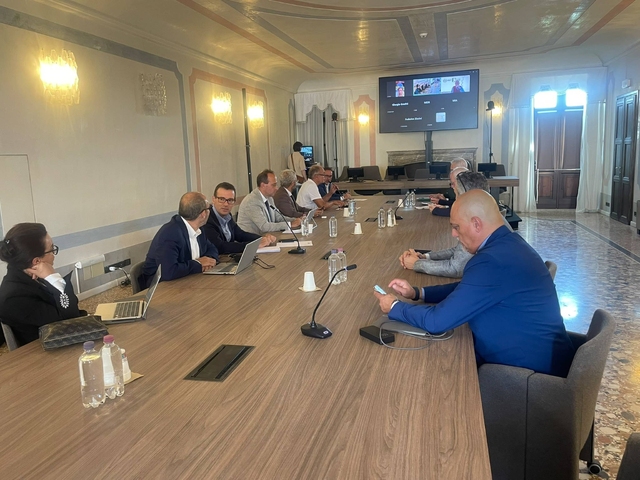
(ANSA) - UDINE, 22 SET - Balkan Corridor 8 as an axis for developing renewable energy exchanges between neighboring countries is one of the issues at the center of work launched by the Italian Energy Communities Forum (IFEC), which aims to connect Italy, Montenegro, Albania, North Macedonia, Bulgaria and Romania. "A Balkan energy community is taking shape here, the so-called Corridor 8," said Sergio Olivero, coordinator of IFEC's four working groups and a representative of the Energy Center at the Polytechnic University of Turin. Tea Sinamati, an environmental expert and board member of Albania's SIEGRA Foundation, said the corridor "can improve connectivity, economic development and cooperation between Albania, Italy and other European countries." Discussions on cross-border energy communities began on Sept. 18 at Colloredo di Monte Albano Castle, which was restored after the 1976 earthquake and recently reopened to the public. There, the Comunità Collinare del Friuli and the RECOCER Foundation brought together institutions, energy operators and Italian and international experts. The Comunità Collinare is the lead partner in the Cross-Border Energy Community Friuli-Goriška pilot project, selected by the European Commission. "Bringing different communities, populations and countries into dialogue is an evolution of the energy community model that is consistent with our history," said Comunità Collinare President Luigino Bottoni. Filippo Bisaro, president of the RECOCER Foundation, said that "the border is now becoming a meeting point between territories, with energy as the common link." IFEC's four working groups are also focusing on incentives and funding after 2027, business models and aggregation. They will compile their findings into "in-depth study papers" to be presented by the end of the year at the sixth National Conference on Energy Communities in Rome. "We will produce work and results that we will make available to institutions," said Paolo Storti of the World Energy Council Italy. (ANSA).