
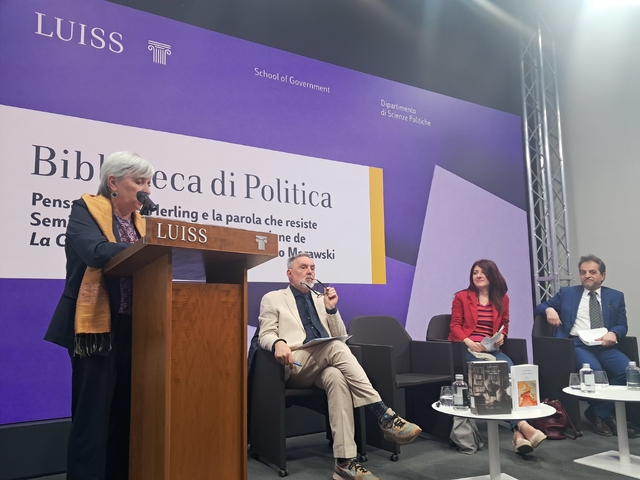
(ANSA) - ROME, 29 APR - Rereading Gustaw Herling to understand the present, between historical memory and current geopolitics. This is the central theme of the seminar 'Thinking about the East - Herling and the Word that Resists', held at Luiss as part of the School of Government's 'Political Library' series, to mark the launch of the book 'The Hinge of Europe', edited by Paolo Morawski and published by Bibliopolis. The book brings together a selection of articles published by Herling - a Polish writer, essayist and journalist who, as an exile, lived in Naples until his death in 2000 - over a period of more than thirty years in leading Italian newspapers, from the "Corriere della Sera" and "Il Giornale" to "La Stampa" and "Il Mattino". What emerges is the profile of a writer capable of combining historical analysis, geographical insight and an eye for the dynamics of dissent within the USSR, offering interpretations that remain relevant today, particularly in light of the conflict between Russia and Ukraine. At the start of the event, Gaetano Quagliariello highlighted the value of a style of journalism that is rare today for its analytical depth, whilst the director of the Department of Political Science at LUISS, Giovanni Orsina, emphasised the relevance of a way of thinking that is always in dialogue with 'the other'. The discussion was moderated by Renata Gravina, a lecturer at Sapienza University, who provided a brief profile of Herling and summarised the book's key themes before introducing the speakers. Among the speakers were Marta Herling of the Italian Institute for Historical Studies, who recalled her father's intellectual commitment to both creative writing and reflection on the present, and Daniele Stasi, Associate Professor of the History of Political Doctrines at the University of Foggia, who described Herling's life as a constant quest for truth through the events of the 20th century. In closing, Morawski highlighted the significance of the title: no longer an 'Iron Curtain', but a 'hinge', a symbol of a Europe to be rebuilt despite tensions and conflicts: thus emerges the figure of Herling as a bridge between cultures, capable of distinguishing between Russian tradition and the Soviet regime, keeping dialogue and testimony alive even in the most difficult times. (ANSA).