
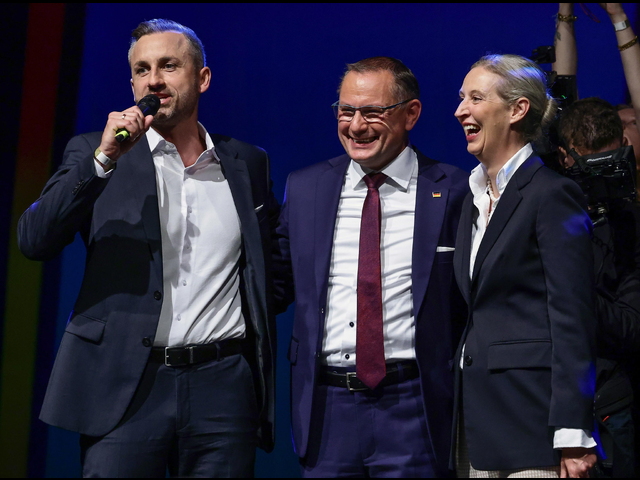
(dell'inviata Rosanna Pugliese) (ANSA) - MAGDEBURGO, SEP 6 - The election on September 6 marks a turning point for Germany and will have an impact on Berlin. Alternative for Germany triumphed in Saxony-Anhalt, buoyed by a record voter turnout for this small eastern state, while the CDU suffered a crushing defeat. And the moment has come for Ulrich Siegmund, the 35-year-old who dreamed of leading a single-party government with a far-right platform that is also resonating strongly with young people. The rising star of the AfD, with his gentle manner and infectious smile, has shocked the country with radical promises, winning over the people—and the result is 44.2% of the vote, according to evening projections. It is not an absolute majority, so in the immediate aftermath he declared: "I don't know yet if I'll be minister-president, but we've already made history." Whether he can form a government will depend on who extends a hand to him. And Sahra Wagenknecht of the BSW—a party on the brink—would be ready to do so. In Magdeburg, at the Maritim Hotel, a sense of despondency hangs over the Christian Democrats' election party, as they have plummeted to 18 percent—half the support they received last time. And the words of outgoing Governor Sven Schulze have sparked a rift within the CDU: "They are the strongest party. We have to face the situation. This is democracy; people turned out to vote in droves, like never before." These remarks make it clear what is happening within Friedrich Merz's party, where the "firewall" isolating the far right is beginning to crumble. And the hard-line chancellor who wanted to cut the AfD in half is now at risk. From the capital, the governing parties—the Greens and the Left Party—are reinforcing the so-called "Brandmauer," or cordon sanitaire: "No collaboration with a far-right party." In the coming hours, however, another important—if not decisive—result will be worth watching: that of Sahra Wagenknecht's BSW, whose leader has already reached out to Siegmund in the immediate aftermath of the election. While ARD's projections show it steady at 5.1%, ZDF's leave it at 4.8%, below the entry threshold. It is precisely this party—which split from Die Linke over opposition to aid for Ukraine, much like the pro-Russian AfD—that will tip the scales in the complex race for a potential first populist government, and this in a region where intelligence agencies classify them as "undoubtedly far-right extremists." Alice Weidel and Tino Chrupalla are struggling to contain their euphoria. "It's a historic, sensational result," said the federal co-chair of Alternative, adding that she could envision "a collaboration with the CDU or with parts of the CDU." In response to the firm stance coming from the capital, she became indignant: "The CDU's disastrous result is due to Brandmuer. People no longer trust the party. If Merz keeps this up, they'll never govern anywhere at the federal level again." It was, however, the Social Democratic Vice Chancellor, Lars Klingbeil, who was the first to state that the vote "is a signal to Berlin." And that this signal will be heeded, changing the course of federal government policy. His Social Democrats received 9 percent of the vote—a disaster, though less severe than predicted. Dismay, fear, but also anger characterize the reactions to an election result that marks a "turning point in the country's history," according to CDU parliamentary group leader Thorsten Frei. And the anger is directed first and foremost at the chancellor, whose position is now at risk. "I want to tell people not to be afraid—you are not alone!" exclaimed the national leader of Die Linke, Heidi Reichinnek, whose party came in third in the state with 9%. But the ball is now in the Union's court—Friedrich Merz had said he would cut the AfD in half. And he failed. It wasn't a good strategy to mistreat Germans by insulting them as slackers." "The reform package is over," adds the party, which should reach out to the Christian Democrats, even though a four-party coalition would now be needed to prevent an AfD-led government in Saxony-Anhalt—a coalition among parties with very different ideologies. "Merz would have been better off staying on vacation," added Franziska Brandt of the Greens, taking another jab at the chancellor, who has remained silent for now. Tensions in Germany remain high: elections will be held on September 20 in Berlin and in Mecklenburg-Western Pomerania. Meanwhile, if Siegmund were to take office, he would have to begin implementing his agenda: ending compulsory education, segregating children with disabilities and migrants into separate classes, and cutting funding for public broadcasting and the churches. All of this is what 15,000 people protested against yesterday in Piazza Duomo—to no avail. (ANSA).