
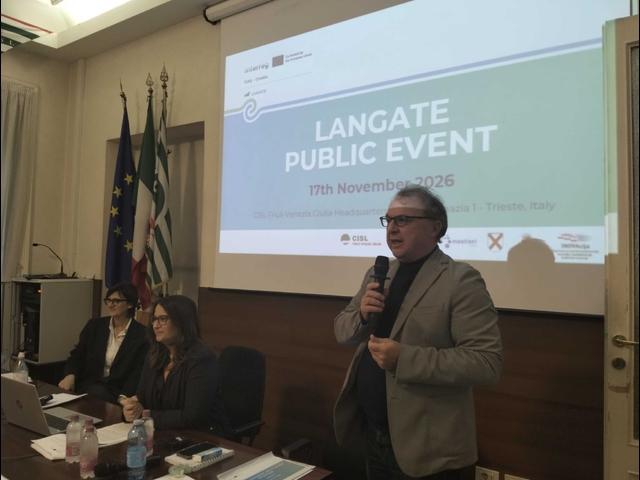
(ANSA) - UDINE, 17 NOV - Six organizations have come together to launch Langate - No Language Barriers 4 Work, Business, Identity and Governance. The project is designed to break down language barriers in the transnational region and promote multilingualism as a key factor in employment, business competitiveness, and social cohesion. CISL FVG is the lead organization, and the project is funded by the Interreg VI-A Italy-Croatia program. In addition to CISL FVG, the partners are the Dubrovnik Entrepreneurship Center, Consorzio Mestieri Puglia, the City of Novigrad-Cittanova, the Municipality of San Felice del Molise and INOVACIja (the Zadar County institution for skills development, innovation and specialization). Trade in services between Italy and Croatia in 2024 was well over 8.3bn euros, but language is still a major barrier. It's a very real issue when you're dealing with technical and professional terminology in particular (tourism, trade, maritime, health care, etc.). Businesses can't find the right people to work in the sector, and workers (especially the younger generation) simply can't access jobs on the other side of the border. Langate tackles this through a three-pronged approach. Phase 1 will focus on mapping and field research to establish exactly where and how language barriers are impacting businesses and workers. Phase 2 will be the development of a bilingual intercultural business communication toolkit, plus a series of cross-border exchanges with young people and professionals. Finally, a permanent network will be in place between public authorities, businesses, chambers of commerce, training bodies, and associations. That network will be formally established via a MoU which will be open to further members. "Between Italy and Croatia, the language of our neighbors should not be an obstacle but an additional skill," said Alberto Monticco, secretary general of CISL FVG. "Via Langate we want to offer workers, young people and businesses training in a real working context". (ANSA).