
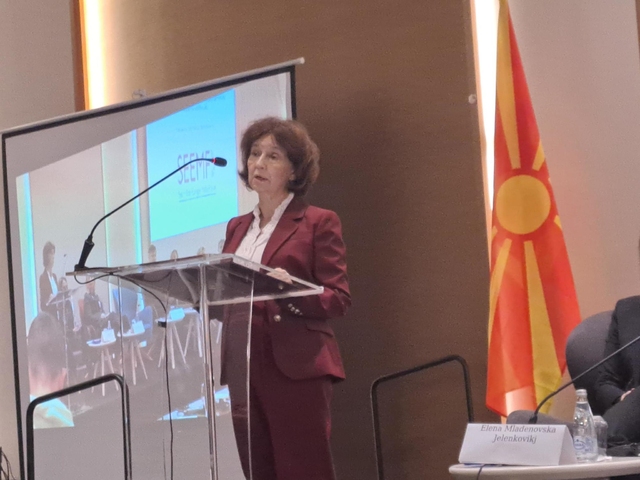
(ANSA) - SKOPJE, NOV 17 - "Without a free and responsible media, there can be no informed 'demos'"; therefore, "democracy risks becoming an empty shell, stripped of its very substance." This was stated by the President of North Macedonia, Gordana Siljanovska-Davkova, during her remarks at the 20th South East Europe Media Forum, organized by SEEMO (South East Europe Media Organization) in collaboration with the Central European Initiative and the EBU (Eurovision and Euroradio). According to the president, "a free press has always been one of the pillars of democracy," "acting as a public 'watchdog.'" But this role, she clarified, "can only be carried out effectively if journalists are truly independent and not controlled by the government." Only then can they "scrutinize its activities and expose abuses of power." Recalling that "in 2025, 128 journalists and media workers were killed, including 9 deaths classified as accidental," the president emphasized that "a journalist's commitment to ethical principles is neither dead nor new" and "requires dedication to the truth and a sense of the 'res publica'." Journalists bear a great responsibility: "Our understanding of politics rarely comes directly from politicians, but rather from radio, television, newspapers, and, above all, the internet and social media." The mass media "do not create reality, but they help shape its public image." And while "new technologies offer ever-greater citizen participation," "media content is often tainted by political biases." Finally, "videocracy and the democracy of spectacle": "Images are increasingly replacing explanation, fleeting impressions are supplanting the broader context, and algorithms are becoming intermediaries between events and citizens. AI opens up extraordinary possibilities, but it also raises new questions about authenticity, the authorship of works, and the credibility of information." According to the Reuters Institute, "social media and video platforms have, for the first time, become the most widely used source of news," but trust in the news stands at 37 percent. Therefore, "a society that fails to preserve the truth about its own time risks losing the ability to shape its own future." (ANSA).